
Smart Government Buildings: The Role of AV Integration in Digital Transformation
April 13, 2026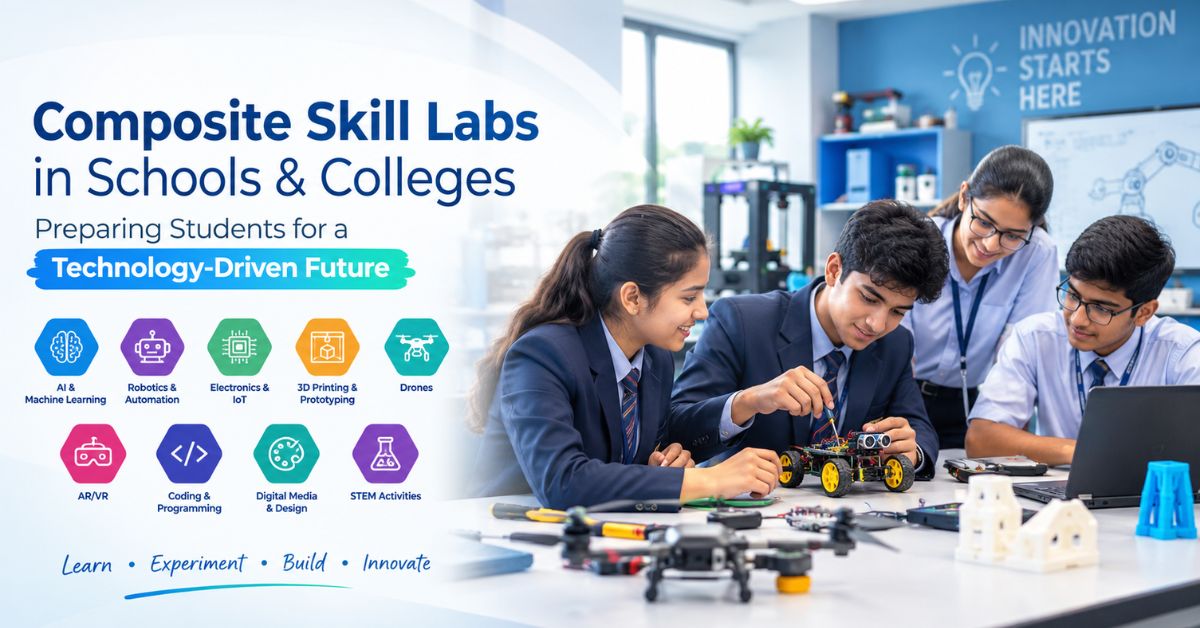
Education is no longer limited to learning concepts from textbooks and reproducing them in examinations. Schools and colleges are increasingly focusing on hands-on learning, practical skills, innovation, creativity and real-world problem-solving.
This changing approach to education has created a growing need for dedicated spaces where students can experiment with technologies, build projects and understand how classroom concepts are applied outside the classroom.
This is where Composite Skill Labs in schools and colleges can play an important role.
A modern Composite Skill Lab can bring together multiple learning areas such as Artificial Intelligence, robotics, electronics, IoT, 3D printing, electric vehicle technology, drones, AR/VR, coding, digital media and STEM activities under one integrated learning environment.
For schools, these labs can introduce students to emerging technologies at an early stage. For colleges, they can provide more advanced project-based learning, prototyping and industry-oriented technical exposure.
The objective is not simply to install technology in an institution. The objective is to create a learning environment where students can learn, experiment, build, test and innovate.
What Is a Composite Skill Lab?
A Composite Skill Lab is a multi-disciplinary educational space designed to provide students with practical exposure to different skills, technologies and real-world applications.
Instead of having separate spaces for every emerging technology, institutions can create an integrated environment containing multiple learning zones.
A Composite Skill Lab may include:
- AI and Machine Learning
- Robotics and Automation
- Electronics and IoT
- Coding and Programming
- 3D Printing and Prototyping
- Electric Vehicle Technology
- Drone Technology
- AR and VR
- STEM Activities
- Machines and Materials
- Media and Creative Technology
- Digital Design
- Entrepreneurship and Innovation
The exact configuration can be adapted according to the age group, curriculum, available space, institutional objectives and level of technology.
Why Do Schools Need Composite Skill Labs?
School education provides an important foundation for students’ future academic and professional journeys.
At the school level, students can be introduced to technology through simple, age-appropriate and activity-based projects.
Instead of simply explaining what a sensor, robot or electric motor is, teachers can demonstrate how these components work together.
For example, students can:
- Build a basic line-following robot
- Create a simple smart irrigation model
- Program a microcontroller
- Experiment with sensors
- Design a 3D-printed object
- Explore AI applications
- Understand basic EV components
- Experience virtual reality
- Create STEM-based working models
These activities can help students connect classroom subjects with practical applications.
Connecting School Subjects with Technology
A Composite Skill Lab can also connect different school subjects.
Physics + Electronics
Students can understand circuits, electricity, motion and sensors.
Mathematics + Coding
Students can apply logical thinking and mathematical concepts through programming.
Science + AI
Students can explore data, classification and intelligent systems.
Environmental Studies + IoT
Students can create projects for monitoring temperature, water or environmental conditions.
Art + 3D Printing
Students can turn creative designs into physical prototypes.
This interdisciplinary approach makes the lab useful across different subjects and grade levels.
Composite Skill Labs for Classes VI–XII:
For secondary and senior-secondary students, skill labs can gradually move from basic activities toward more structured projects.
Classes VI–VIII
Students can be introduced to:
- Basic robotics
- Electronics
- Sensors
- Coding fundamentals
- STEM projects
- 3D design
- Simple IoT applications
- Digital creativity
The emphasis can be on exploration and curiosity.
Classes IX–X
Students can move toward:
- Advanced robotics
- IoT projects
- AI fundamentals
- Programming
- Automation
- 3D printing
- Drone technology
- Electronics projects
Students can begin solving defined problems through project-based learning.
Classes XI–XII
At the senior-secondary level, institutions can introduce more advanced projects involving:
- AI and machine learning
- Robotics
- Advanced IoT
- Automation
- EV technology
- AR/VR
- Engineering prototypes
- Data analysis
- Research-oriented projects
This can provide students with exposure to technologies relevant to higher education and emerging career pathways.
Why Do Colleges Need Composite Skill Labs?
The requirements of colleges can be different from those of schools.
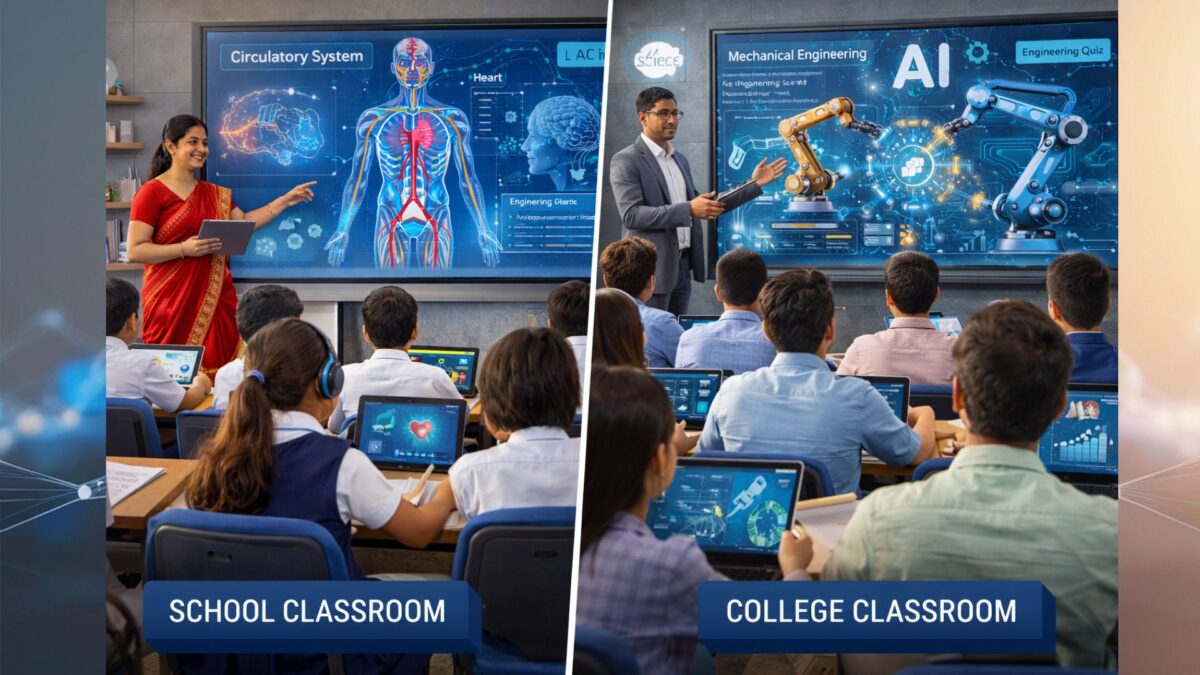
While schools may focus on awareness, exploration and foundational skills, colleges can use skill labs for advanced practical learning, prototyping, research, innovation and industry-oriented projects.
A college-level Composite Skill Lab can support students from disciplines such as:
- Engineering
- Computer Science
- Electronics
- Mechanical Engineering
- Electrical Engineering
- Automobile Engineering
- Design
- Media
- Management
- Vocational Education
- Applied Sciences
Students can work on projects that combine multiple technologies.
For example, an engineering student could design an IoT-based monitoring system, while an automobile student could explore EV systems. Computer science students could work on AI or automation, while design students could develop physical prototypes using 3D printing.
School Skill Labs vs College Skill Labs:
Although both schools and colleges can benefit from Composite Skill Labs, the learning approach can differ.
| Schools | Colleges |
| Technology awareness | Advanced technical application |
| Foundational coding | Advanced programming |
| Basic robotics | Advanced robotics and automation |
| STEM projects | Engineering prototypes |
| Simple IoT projects | IoT and embedded systems |
| Introduction to AI | AI/ML applications |
| Basic 3D printing | Product prototyping |
| Technology exploration | Research and innovation |
| Guided projects | Independent projects |
The same infrastructure can therefore be configured differently depending on the institution.
AI Labs for Schools and Colleges
Artificial Intelligence is becoming an important area of technology education.
A school-level AI Lab can introduce students to concepts such as:
- What is AI?
- How machines recognise patterns
- Basic machine learning concepts
- Computer vision
- Generative AI
- AI-assisted creativity
- Simple AI projects
At the college level, students can move toward:
- Machine learning
- Data analysis
- Computer vision
- Natural language processing
- AI application development
- AI-enabled automation
When AI is combined with robotics, students can understand how intelligent software can control physical systems.
Robotics Labs for Hands-On Learning
Robotics is particularly suitable for both schools and colleges because it combines several disciplines.
A school robotics program can introduce:
- Motors
- Sensors
- Controllers
- Basic programming
- Robot construction
- Automation
College students can progress toward:
- Robotic arms
- Autonomous robots
- Industrial automation
- Computer vision
- AI-enabled robotics
- Advanced control systems
Robotics projects can also encourage teamwork because students often need to work together on mechanical, electronic and programming components.
IoT Labs: Connecting Students to Smart Technology
The Internet of Things (IoT) is another important area for Composite Skill Labs.
School students can create simple projects such as:
- Smart lights
- Temperature monitoring
- Smart irrigation
- Automatic dustbins
- Smart classroom models
College students can work on more advanced applications such as:
- Industrial monitoring
- Smart agriculture
- Energy monitoring
- Smart campus systems
- Environmental monitoring
- Connected devices
This allows students to understand how sensors, networks, software and physical devices work together.
EV Labs for Schools and Colleges
Electric vehicle technology can introduce students to an important area of modern engineering and mobility.
An educational EV Lab can demonstrate:
- Electric motors
- Batteries
- Controllers
- Charging systems
- Battery management
- Electrical safety
- Vehicle electronics
For schools, EV learning can focus on basic concepts and demonstration models.
For colleges, EV labs can support deeper technical learning, experiments and project work related to electrical, mechanical and automobile systems.
EV technology is particularly valuable because it combines multiple disciplines:
Electrical Engineering + Electronics + Mechanical Systems + Software + Automation
3D Printing and Prototyping in Educational Labs
One of the most engaging activities in a skill lab is turning an idea into a physical object.
With 3D printing, students can:
- Identify a problem
- Create an idea
- Design a digital model
- Prepare the model for printing
- Produce a prototype
- Test the design
- Improve it
Schools can use 3D printing for simple educational models and STEM projects.
Colleges can use it for:
- Engineering prototypes
- Product design
- Mechanical components
- Research projects
- Architecture models
- Innovation projects
This creates a practical connection between design, engineering and manufacturing.
AR and VR Labs for Experiential Education
AR and VR can make learning more immersive.
For schools, VR can provide experiences related to:
- Science
- Geography
- History
- Space
- Human anatomy
- Engineering concepts
For colleges, VR can support:
- Engineering simulations
- Industrial training
- Medical education
- Technical demonstrations
- Architecture and design
- Safety training
Rather than replacing classroom teaching, AR/VR can complement conventional teaching by providing students with experiences that may be difficult to recreate physically.
Drone Technology in Schools and Colleges
Drones can introduce students to concepts involving:
- Aerodynamics
- Sensors
- Electronics
- Programming
- Navigation
- Imaging
- Automation
School students can learn basic drone concepts and supervised applications.
College students can explore more advanced areas such as drone programming, mapping, imaging, surveying and autonomous systems, subject to applicable regulations and safety requirements.
From STEM Projects to Real-World Problem Solving
A successful Composite Skill Lab should encourage students to work on problems rather than only demonstrations.
For example:
Problem:
How can a school reduce water wastage?
Student Solution:
Students could combine:
IoT sensors + Programming + Automation + Data Monitoring
Another example:
Problem:
How can a small vehicle become more energy efficient?
Students could explore:
EV technology + Sensors + Electronics + Data
This type of project helps students understand how multiple subjects and technologies work together.
Skill Labs and NEP 2020
The focus on experiential learning, competency development, vocational exposure, creativity and critical thinking makes practical learning an important part of modern education.
A well-planned Composite Skill Lab for schools and colleges can support these educational objectives through:
- Hands-on activities
- Project-based learning
- Experiential learning
- Vocational exposure
- Innovation
- Creativity
- Collaboration
- Problem-solving
- Technology awareness
The lab can complement classroom education by giving students opportunities to apply concepts through practical activities.
What Should a School Composite Skill Lab Include?
A school-focused lab can include different learning zones depending on available space and curriculum requirements.
AI & Coding Zone
For programming, AI activities and computational thinking.
Robotics Zone
For robot building, sensors, motors and automation.
Electronics & IoT Zone
For circuits, microcontrollers and connected devices.
STEM Zone
For science, technology, engineering and mathematics projects.
3D Printing Zone
For design, modelling and prototyping.
AR/VR Zone
For immersive learning and simulations.
Creative Technology Zone
For digital design, media and creative projects.
What Should a College Composite Skill Lab Include?
A college-level setup can incorporate more advanced infrastructure such as:
- AI/ML workstations
- Robotics systems
- IoT development kits
- Embedded systems
- 3D printers
- CNC or fabrication equipment where appropriate
- EV training systems
- AR/VR systems
- Drone technology
- Electronics workstations
- Prototyping tools
- Technical software
- Digital collaboration systems
The configuration should be aligned with the college’s courses, departments, student projects and industry requirements.
How Can Institutions Plan a Composite Skill Lab?
Before setting up a lab, schools and colleges should consider:
1. Student Age and Academic Level
Equipment and activities should be appropriate for the learners.
2. Curriculum
The lab should complement academic subjects and practical learning requirements.
3. Available Space
The layout should provide adequate space for equipment, demonstrations, student activities and movement.
4. Safety
Electrical equipment, tools, batteries, machinery and other systems should be used with appropriate safety measures and supervision.
5. Faculty Training
Teachers and faculty members should receive appropriate training so they can effectively use the equipment.
6. Project-Based Learning
The lab should encourage students to create projects rather than using equipment only for demonstrations.
7. Future Expansion
Modular infrastructure allows institutions to add new technologies as learning requirements evolve.
From School Innovation to College-Level Specialisation
A major advantage of a well-planned skill-lab ecosystem is that students can gradually develop their skills.
A student might begin with:
School → Basic Coding
then progress to:
Robotics → IoT → AI → Advanced Projects
and eventually explore:
College → Specialised Engineering / Technology Projects
This creates continuity between school-level technology exposure and higher education.
Building Future-Ready Students
The purpose of a Composite Skill Lab is not to make every student an engineer or programmer.
Instead, it can help students develop capabilities that are useful across different academic and professional paths:
- Critical thinking
- Creativity
- Communication
- Collaboration
- Digital literacy
- Problem-solving
- Design thinking
- Technical awareness
- Project management
- Innovation
These skills can complement traditional academic learning and help students understand how technology is applied in the real world.
Conclusion
Composite Skill Labs in schools and colleges can provide a structured environment for students to move beyond theoretical learning and explore practical applications of emerging technologies.
For schools, the focus can be on curiosity, foundational technology skills, STEM learning and exploration.
For colleges, the focus can expand toward advanced projects, prototyping, research, innovation and industry-oriented skills.
From AI and robotics to IoT, EV technology, 3D printing, drones and AR/VR, a modern skill lab can bring multiple disciplines together under one learning ecosystem.
The most valuable outcome is not simply that students learn how a technology works. It is that they learn how to use technology to understand problems, develop ideas and create solutions.
For educational institutions planning a Composite Skill Lab setup, the right combination of infrastructure, equipment, faculty training and project-based learning can create a future-ready environment for students from school through higher education.
The future of education is not only about learning technology. It is about giving students the opportunity to create with it.